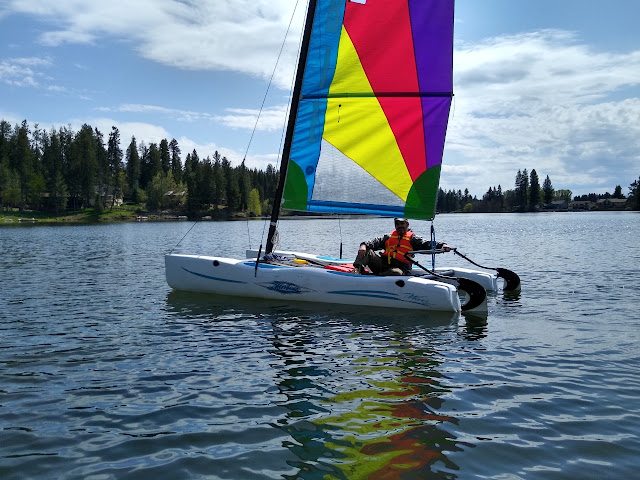
Hello fellow sailors. It was a sad day on September 12 when I taught my last group sailing class of 2026 (private lessons still available). Like each year it always comes to an end. I do get a break and get to enjoy the holidays with my family and friends, so there is that.
I do keep sailing in the winter, mostly on my little Hobie Wave catamaran sailboat. I have even sailed on snowy days. I have sailed on Lake Coeur d'Alene and Hayden Lake (Idaho USA) when most of the lake was frozen (see vid below). I will be posting some winter sailing videos so stay tuned by visiting this site regularly. Sailing in the winter is also my training for the 2028 Race 2 Alaska.
The good news is our 2027 sailing class dates for the Complete Sailor 101 have been posted. Will soon have our 2027 Small Boat 100 classes dates posted.
If you have taken a class in the past and would like to take the classroom portion again as a refresher, we offer the indoor class in-person or via video.
We will likely be adding "Spinnaker sail class" for 2027. If you do not know what a spinnaker sail is, it's a sail that looks like a big balloon forward of the mast off the bow.
We will also be offering small boat trapezing class as well.
In 2027 for the Small Boat 100 classes, we will be adding an end of the season regatta and potluck. So past students can come to the regatta and race fellow students. And students who did not take the Small Boat 100 class can come and watch, east food. It's actually nothing serious, just a fun get-together, with some not serious racing.
And finally, Mindy our Small Boat 100 instructor is planning a Halloween class in October 2027. Come dressed up in your favorite scarry costume, etc. More info coming soon.
A boating accident that killed 3 girls at a summer sailing camp in Biscayne Bay Florida brings to light the dangers of sailing in a busy channel, particularly on that day with light winds, reducing speed and maneuverability of the sailboat. It appears the 5 girls and a 19-year-old female instructor were in a main navigable channel with little ability to sail at any good rate of speed when they were struck by a tugboat pushing a construction barge. The barge ended on top of the sailboat, a Hobie Getaway (17’ long), with the girls attempting to jump and swim out of the way. 3 of the girls were struck and drowned resulting in their deaths. Very tragic. My thoughts and prayers are with their families. On the side note, all the girls were wearing life jackets.
I live near the Snake River where tugs pushing grain barges are a constant sight. The question has been asked why the tugboat skipper did not stop or avoid the collision. The non boater/land lubber this seems like good questions but for us experienced boaters/skippers its more complex.
Boating rules state that boats with limited draft and maneuverability have rights over boats that are more maneuverable. We all the boat with so called right away as the Stand On Vessel and the boat that does not have right away is Give Way Vessel. In reality both boats need to avoid a collision. And in reality, the small sailboat was the Give Way Vessel. It is likely the tugboat skipper never saw the sailboat due to all the gear and crane on the barge. Big mistake on the tugboat captains' part as you must have a look out on the front of the barge. The sailboat skipper could see the tugboat coming but seemed to not take evasive action well in advance of the accident. It is the skipper's responsibility to be aware of their surroundings and act accordingly to prevent an incident. Some would say the wind was light, which it was, and had no motor, which is correct. The best option would have been to not sail on light days in the channel when busy and to paddle and/or skull the boat out of the way of the tugboat. Channels should be avoided and only crossed when needed. Again, maneuver out of the way well in advance. With an added note, we sailors all know the wind can die without notice, so the sailboat could have had wind and then it died. From the report there is not a note about the wind but in imagens we can tell there is little wind. Also, on very windy days one would not want to capsize in a busy channel resulting in being ran over.
Some might ask what the tugboat captain could have had done. He should have had a lookout or some type of video camera in his cabin showing all in front of the barge. That was his main mistake that likely will cost him legally. What I do not know is if the skipper saw the sailboat but could not maneuver in time. Did he blow his horn, warning the sailboat skipper that might have not been paying attention, or assume the tugboat could maneuver around them (not a correct assumption).
The reality is that the sailboat skipper made a fatal mistake, she was in the wrong and did not take action early enough to avoid getting hit. The tugboat captain had few options due to being restricted to the channel by draft and maneuverability. However, his lack of a lookout is a big problem and breaks a big navigation rule. His main option would have been to slow down at least or put the motors in reverse (if conditions allowed); there really was not much he could do once near the sailboat.
I am not trying to put all the fault on the young female skipper as we all make mistakes but sadly, in this incident, obviously it was a fatal mistake.
My other thought is that this was part of the Maimi Yacht Club sailing program in a busy boat traffic area. Why was there not a support boat looking out for the campers/sailors. And if they had a support boat, why were they not watching sailors in this busy channel. A support boat could have easily moved the sailboat out of the way, out of the channel.
So where is the blame, really it's on all parties… Tugboat captain did not have a lookout and was not blowing his horn, the young skipper did not act soon enough (getting out of the way); And the yacht club did not have proper on the water support. In the end it’s an epic tragedy that could have been avoided, one we all can learn from.
I have been asked the following several times by students of mine... Can a sailboat use a fan to make it sail forward? The answer is no, so why not? Because if you have two forces acting equally on each other, then you are going nowhere. The 2 forces, fan and sail, cancel each other out.
If you use the sail only via the wind, then of course you will sail forward. If you use the fan only against the air you get a fan boat and you move forward, stick the fan blade in the water like a propeller in the denser air called water and you have even more density to push against and again you move forward.
So, it's obvious use sail only or motor only with a fan in the air or propeller in the water to move forward.
Mark Rober talks about this in his video "Testing if you can blow your own sail (see video below)." He also talks about the density of the air that also plays into a sailboat sailing and other affects that are quite interesting.
In addition, Mark points out the importance air density, known as air pressure... On ground there is more air pressure because there are more air molecules, higher up like on the top of Mt Everest, there is much less air pressure, less air molecules. Air molecules weigh more down low than higher up. Gravity is pulling on the air molecules. A helium ballon will rise because its lighter than the air molecules around it. Thus, a sailboat will sail better with more air pressure versus less, but for us sailors the air pressure is always good as we mostly sail at sea level or on lakes that are higher up inland but still have more than enough air pressure.
Mark Rober full video is super interesting, so of course watch the full video below. He makes kits that you can buy to experiment on varies scientific and engineering topics. Well worth the cost for kids and the young at heart. Click this link to visit his website to purchase.
Watch the air pressure topic at the 3 minute and 8 second mark.
Watch just the fan and sail experiment at 5 minutes and 42 second mark.
The whole video is interesting to watch and learn from.
We have great prices on Radio-Controlled and Pond Sailboats, Kites such as Stunt, Pocket, and Floater Kites, Sailing Knives, etc.Click Here!
One can also make a donation to the non-profit Access To Outdoors to support marine access work, accessible sailing, and other projects. To donate email accesstooutdoors@gmail.com
I thought this video was a perfect example of why powerboaters should never make a video about the problems with sailboats as it devolves into silly arguments against sailboats because the lack of any real knowledge on this topic. I think if one does a video about the pros and cons of powerboats versus sailboats its better to drop the pros and cons and simply note each boats characteristics, usage, etc. Let the reader or listener make the choice of what is best for their needs.
However here is my evaluation of this powerboater, Wayne the Boat Guy video called "Sailing: The Problem With Sailboats." See his video below.
I do not want my comments to be negative but its obvious Wayne has never sailed. His comments are what I find typical of power-boater mentality. Seriously why even make a video about a thing you know nothing about. I would never do a video on racing cars because I know nothing about it.
I am going to comment related to each of his 5 points on his video about the problem with sailboats.
1. Steep Learning Curve: This depends on what you are going to sail. I run a sailing school, teaching on small boats up to 18', small catamarans and sportboats (what some may call trailer-able keelboat). I teach basic small boat (capsize-able boats) and big boat (non capsize-able boat with cabin) classes, that includes safe boating. Both of these classes are one day classes starting at 7am and ending at 6pm. I teach the required safe boating stuff and basic sailing, by the end of the day all my students sail well, mainly because I keep it simple. So in a day with any excellent instructor one can learn to sail. After this class one can build on their knowledge and base skills layer by layer until one is highly proficient. The fact you can motor your powerboat out and back to the dock with no or little skill is nothing to brag about, all boaters no matter a sailor and powerboater should all take classes. There are far more powerboat accidents than with sailboats, why because sailors have to be knowledgeable, they can't just turn the key on and go. Wayne says driving a boat is similar to a car in spite of having no brakes, etc. Really, like a car? No brakes, hull moving through the water, etc. is just like driving a car. Sorry that is quite a stretch.
2.The Weather has to be just right: Well he obviously does not understand weather. No, the weather does not have to be perfect as he states. Are you kidding, have you seen all the variable weather that sailors sail in. I think he is talking about no wind or little wind. My students have learned to say “there is always wind.” Now I am joking kind of, however the air is rarely not moving, if the air is moving, there is wind. The boats I sail can sail in a whisper of wind. None of my boats have motors. I have oars, paddles, or other human powered options. I grew up in Westport WA sailing on Grays and Willapa Harbors, and the Pacific Ocean and never used a motor, not once. Now I know I am the extreme example even with sailors. What I have learned is to watch the weather and tides/currents. New powerboaters and those who are not very educated would be wise to learn a lot more about the weather, as the weather can significantly impact ones boating. The weather can kills you! Does not matter if your a sailor or powerboater. Sailors are known to work well with weather, most powerboaters not so much.
3. Going Solo: He says its not easy to sail solo. Actually its so so easy to solo sail. If a sailor solos a lot he will own a sailboat that is easy to do that with. Heck I had a 33' racing catamaran with a 16' beam, 54' tall mast, and sailed it solo all the time. love to solo sail it. I still regularly solo sail. Sure it takes skill to sail solo, but once your an experienced sailor one can easily solo sail. I am solo sailing a small sailboat to Alaska in 2025. There are a lot of weekend warrior sailors, or martini sailors as they are called that simply do not take the time to learn to sail solo, they are the ones you see always motoring their sailboat, with the sails never up. That is fine if one wants to do that but do not judge the ease or not of solo sailing from them.
4. They Are Slow: Oh boy this guy has no clue on speed. Sure most keelboats and big house boat like catamarans are slow, however there are many sailboats that are much faster. I had my 33' cat up to 26 knots. I could regularly sail her at 15-18 knots. Under motor power it was easy to have her at 10 knots. So there is a lot of variability in sailboat designed related to speed. I should note all the around the world speed records on water are by sailboats, none by powerboats. If you watch SailGP racing, those foiling catamarans reach speeds up to 60 miles per hour.
5. More Work: "More work? More Preparation?" No matter a powerboater or sailor one should be prepared. Before I go sailing I supply a float plan to someone that will notice if I do not get back in a reasonable time (if you do not know what a float plan is, that is a big problem). When I go to sailing it does not take hardly any work, because my boat is always prepared for any trip. All I really need to do is check the weather and pull up my sails and off I go. Pretty simple. Rigging, if your boat is at a dock it takes little work to do and go. Sure you have to take the covers off the sails (extends the life of the sails), about a 5-15 minute process. If you trailer your boat, sure rigging takes more time, but again it depends on the sailboat. The rigging as he calls it is already set up, what is there to do really. My Hobie Wave literally takes about 15 minutes to rig and launch.If you are driving a powerboat are you really going to just tie to the dock and turn off the motor(s), and go. Really, your not going to do anything else with your motor? If your on salt water are you not going to clean out your system? Not going to lock up, check the boat, etc. He notes if it is hot putting the sails away is difficult? Boy I never knew sailing was so hard before listening to him. I have sailed for 57 years. Nope, not hard to me. I see all the work my friends have to put into their motors (repairs, etc.) and cost of gas and oil, etc., which always makes me thankful to be a sailor. I especially love when I sail by them when their motors die (as long as I know their ok I will sail by). I am being funny but Wayne may want to start exercising if he thinks such low effort requires so much work.
On the topic of hating power-boaters, the reason some sailors dislike power-boaters is simply what Wayne's attitude is. He says "I can take my boat out with no training and boat." This is the problem! Most power-boaters are uneducated. You take training to drive a car, yet they think no training is needed to drive a boat, and that is just not true and its also a dangerous way to think. Powerboaters are not suppose to create a wake within 100 feet of a sailboat, boats not moving or anchored, or other non motorized watercraft, yet they do it all the time, why because they have no clue. I could make a very long list of what I see powerboaters do wrong almost every time I boat, not so with sailors. The good news is at least safe boating certifications are now required in all but 4 states. Hopefully those 4 states will be on board soon. You might notice these certifications are for powerboats of 10-15 hp or more. No such requirement for sailors. Food for thought, hint its because 99.9% of all boating accidents are by powerboaters. I suggest all powerboaters take a sailing class also. When you get caught in a big wind storm, etc. you will be better able to handle it because you will be much more aware as a sailor, much more aware of their environment and how windage affects the boat, etc.
I am not trying to be negative but seriously this video did not really teach the truth about sailing because its from the perspective of a powerboater with no sailing experience. So I was not surprised he got almost all of it wrong. Hopefully some day someone can make a factual video about the skills needed for powerboats and sailboats, without the biases. I am going to do such a video, so stay tuned.
Miles Moore of FunToSAIL will be applying to enter the Race 2 Alaska as Team FunToSAIL.com in 2025. This is a 750 m/1207 km race from Port Townsend WA USA to Victoria CAN (Vancouver Island), and onto Ketchikan Alaska. No gas or electric motors allowed, all muscle or sail power, or both.
Teen sailors. One holding the head of Wilson... "its October... Halloween."
Spent a beautiful day in October 2022 on Hayden Lake Idaho practicing overboard recovery of Wilson the volleyball. Three teenagers learning to sail and practice picking up Wilson and type 4 throwable. If you want to learn to sail to a dock but are concerned with hitting the dock under sail, I recommend practicing overboard recovery drills, as when you do so you're learning to stop and go, and those skills are transferable to safe docking.
The Malbec 18 sportboat is provening to be the ideal boat for my students to learn to sail on. Learn more about this boat at this link... Malbec18
Come to out to our event and receive a free Life Jacket (availability limited), sign up for a safe boating class, and check out the Sheriff Boats, Sailboats, Kayaks, etc.
Remember National Wear Your Lifejacket to Work Day is Friday May 20th, 2022. When people ask you why you are wearing a Life Jacket you can tell them it's to bring awareness of the importance of wearing one to stay alive.
LEARN ABOUT SAFE BOATING AT THIS ANNUAL EVENT AND THROUGHOUT THE YEAR VIA NOTICES AT FUNTOSAIL.COM & SHERIFF MARINE DEPARTMENTS! THIS EVENT IS ATTENDED BY KOOTENAI AND SPOKANE SHERIFF MARINE DEPARTMENTS, US COAST GUARD, ACCESS TO OUTDOORS, AND INLAND NW MARINE BUSINESSES.
SUPPORT SAFE BOATING IN THE INLAND NORTHWEST BY BECOMING A SPONSOR/DONOR &/OR VOLUNTEER. Email us at accesstooutdoors@gmail.com to learn more. Funding in particular helps support our many marine projects.
Current Sponsors... Kootenai County Sheriff Marne Division; Idaho Parks and Rec; Access To Outdoors; Inland Northwest Sailors; FunToSAIL; Fins & Feathers Tackle Shop; Black Sheep
Learn about the many great places to boat within the Inland NW at the LakeS Guide via this link... Lakes Guide
Here is how to do a Hobie Wave (for any catamaran really) capsize scoop recovery. The goal is to scoop the crew into the boat while one is righting the boat. This allows one to get on board with little effort then if needed they can assist the one in the still in the water onto the boat.
Basically what you do is one sailor does the capsize recovery as noted. The one being scooped simply lightly hangs onto the trampoline hiking straps, so has not to created extra resistance for the sailor righting the boat. As the boat starts coming over to an upright position the one being scooped kicks as the boat comes over, making sure they are on the boat. Pretty simple process. This process of course can be applied to righting a monohull.
Have any questions please leave a comment on the video or on this post below.
Kootenai County leads all counties in Idaho with the most registered vessels, followed by Bonner County (Lake Pend Oreille). Spokane County leads all counties in Eastern WA with the most registered boats. And Flathead County has the most boats registered in Montana. On top of that these areas have a large non motorized boating and water enthusiast population. With many boats register and active non-motorized enthusiasts comes with more boating accidents and drownings. Not to mention the Inland Northwest is a boating paradise with its vast marine environments of small and large lakes/reservoirs and many rivers. All this combined creates a unique and daunting challenge for marine law enforcement. Sheriff Marine divisions of the Inland NW asks all marine enthusiasts to make a difference in prevent recreational marine accidents. Here are 10 things you can do to accomplish this...
Federal law requires the operator or owner of a recreational vessel to file a boating accident report with the State reporting authority if the recreational vessel is involved in an accident that results in any of the following:
· A person dies
· A person is injured and requires medical treatment beyond first aid
· A person disappears from the vessel under circumstances that indicate death or injury
· Damage to vessels and other property totals $2,000 (lower amounts in some states and territories)
· The boat is destroyed
2. Boater Education (email FunToSAIL for more info)
Boating safety courses are offered for all types and ages of recreational boaters. These courses are conducted by qualified volunteer organizations, such as the The Sheriff Marine Divisions, U.S. Coast Guard Auxiliary, U.S. Power Squadron, and other sponsors including state boating agencies. FunToSAIL.com offers sailing lessons for those interested in learning to sail small daysailors such as Hobie Cats to coastal sailing for keelboaters/multihullers.
Both the U.S. Coast Guard Auxiliary and the United States Power Squadrons have certified vessel examiners who will perform a free Vessel Safety Check ("VSC") at your boat, at a time of mutual convenience.
The U.S. Coast Guard says boaters should file a float plan before embarking on the water. Why? The answer is simple... there are just too many facts that need to be accurately remembered and ultimately conveyed in an emergency situation. Without a float plan, you are counting on someone else, a friend, neighbor, or family member to remember detailed information that rescue personnel needs in order to find you. Information can make a difference in the outcome.
Carbon monoxide (CO) can harm and even kill you inside or outside your boat. The U.S. Coast Guard urges boaters to educate themselves about the dangers of carbon monoxide.
BUI is just as dangerous as driving under the influence (DUI). The leading contributing factor in fatal boating accidents is alcohol. Alcohol and water do not mix.
Boats designed for shallow water fishing or recreational use are most prone to shallow water accidents, according to the U.S. Coast Guard. These boaters need to know how to handle this situation before going out on the water.
Boat propellers are a hidden danger to boaters. To avoid boat propeller accidents remove keys from the ignition when stopping. Make sure your motor safety lanyard is attacked to the safety off switch and is attached to the skipper/person who is driving the boat.
CONCLUSION: Doing these 11 things will help you and others to have a safe boating experience. If you see unsafe boaters such as those under the influence of alcohol write down the boats registration number and report to the local marine enforcement (should have this contact info on your float plan and on your boat). Take immediate action if one can do it safely. Do not engage drunk or violent acting individuals/groups. Best to contact law enforcement while on the water via VHF radio safety channel. Cell phone signals are not always reliable while on the water.
It is finally here, our new Adventure Coastal Sailing class, designed specifically for sailors who sail shallow draft sailboats up to 27 feet/8.2 meters, and for those wanting to sail bigger coastal cruising sailboats but need the skill first.
Our primary instructor Miles Moore has taught classes like it before but this class is new in the fact it creates a whole new lesson format that specifically targets those people who want to camp sail, or use a small shallow draft sailboat to access areas of coastal environments that are not accessible to larger cruising sailboats.
Nice day of sailing in September 2020 in Hayden Idaho USA. For those of you wanting to sail in high winds (15-25 knots) my video commentary may help. If you have any questions make a comment at the bottom of this page.
Attention sailing students who have taken our 100 Small Boat Sailing class! October 3rd will be FunToSAIL's first annual student sailing regatta/race and BBQ.
Current and past students only. Anyone is welcome to come and watch. Come dressed up as a pirate or Navy/Seamen, etc. Get a few extra points for your costume.
It will be a fun day of racing to show off your skills developed or skills to be developed, and attire. Seriously its all fun and games.
Miles Moore your instructor will teach you how to race and have fun doing it.
Price to attend is $15/person. Please contact us so we know your coming... funtosail@gmail.com or text 208-704-4454.
So join us for a day of FUN and food! If you do not come it just means more food and fun for the rest of us, so don't miss it!
ATTENTION... Join our most popular sailing class while we have openings. We have classes Fridays and Saturday into October. Also have Big Boat/Keelboat/Multihull classes and classes for those with disAbilities, and for those seeking more high performance instruction. Classes start at 7:am. To learn more or sign up for a class visit this link... 100 Small Boat Sailing Class/Sign Up
First sailing lessons took place May 2nd aboard our Hobie Wave catamaran sailboats. Join us our next classes in June. Learn more about our classes by Clicking Here!